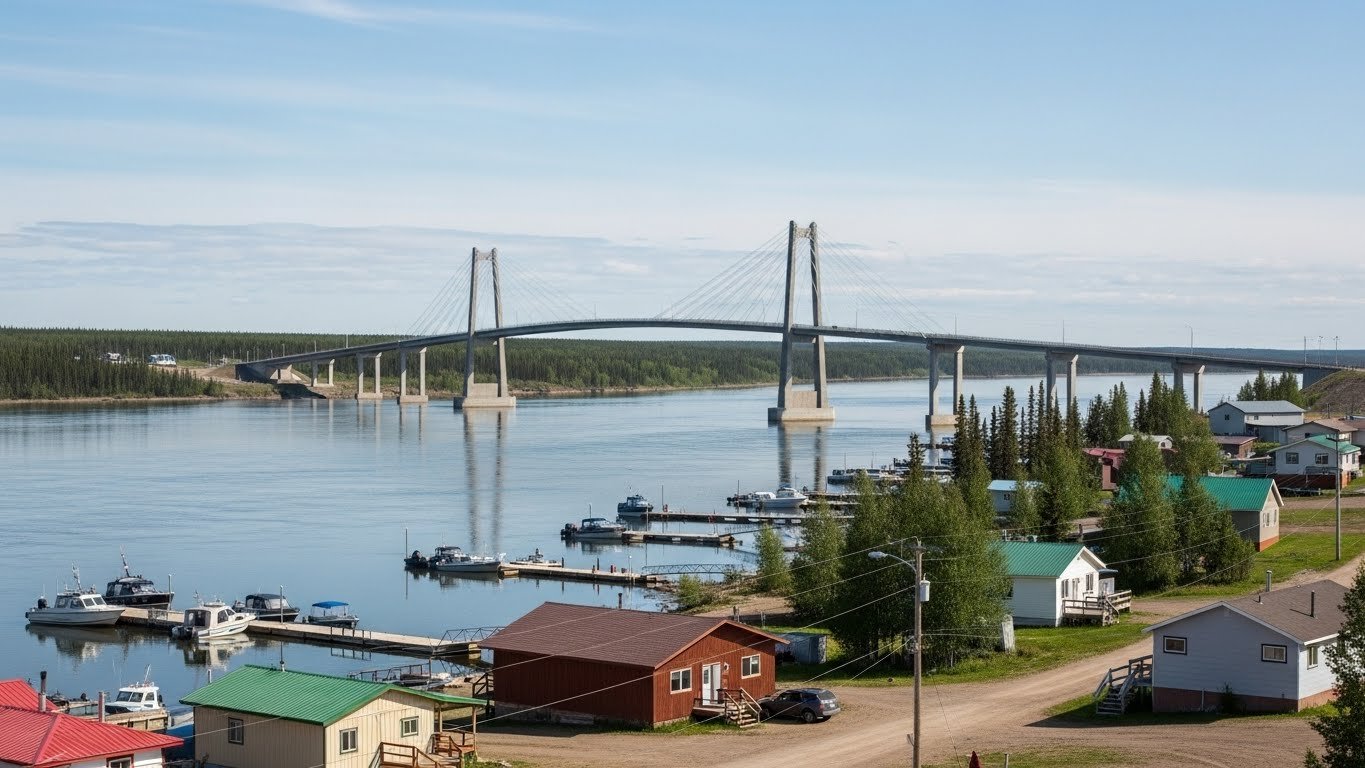

Some places announce themselves loudly with skylines and crowds. Others speak more quietly—through the steady flow of a river, the strength of a bridge, and the enduring presence of a community that has guided travelers for generations. Fort Providence belongs firmly to the second kind.
Located along the great northern waterways of the Northwest Territories, Fort Providence is best known today for the remarkable Deh Cho Bridge, a modern engineering landmark that transformed travel across the North. But long before steel and concrete spanned the river, Fort Providence was already a place of movement, meaning, and connection.
As a former teacher and a mother who believes travel should deepen understanding—not just fill photo albums—I find Fort Providence deeply compelling. It is a community where transportation, culture, and resilience come together in ways that quietly shape the North.
First Impressions: Calm, Confidence, and Continuity
Arriving in Fort Providence, the first feeling is not rush but steadiness.
The landscape is wide and open, the air clean and unhurried. The community sits with a kind of confidence that comes from knowing its role—past and present—in northern life. This is not a place trying to reinvent itself for visitors. It is a place that understands its importance and carries it with humility.
Fort Providence feels lived-in, practical, and welcoming without being performative. You sense immediately that people here know the land, the river, and one another.
A Historic River Crossing Community
For generations, Fort Providence has been an important river crossing point along the mighty Mackenzie River. Long before modern roads existed, rivers were the highways of the North, and this community played a vital role in guiding people, goods, and stories across the water.
The river shaped:
- trade routes
- seasonal travel
- communication between communities
- cultural exchange
Fort Providence grew not because of convenience, but because of necessity. The river demanded respect, patience, and skill—qualities that still define the community today.
The Deh Cho Bridge: A Modern Northern Landmark
The Deh Cho Bridge is more than an engineering achievement—it is a symbol of connection.
Spanning the Mackenzie River, the bridge replaced seasonal ferry and ice-road crossings, transforming how people move through the region. For travelers, crossing it feels momentous. The river below is vast and powerful, and the structure above it feels purposeful and elegant.
But what moves me most is how the bridge fits into the community’s story. It did not erase Fort Providence’s role as a crossing—it reinforced it.
The bridge:
- strengthens regional transportation
- supports economic activity
- improves year-round access
- honors Fort Providence’s historic role
As someone who appreciates how old and new can coexist respectfully, I find this balance deeply satisfying.
Cultural Significance Rooted in the Land
Fort Providence is not just a transportation hub—it is a cultural community with deep roots in Indigenous traditions and northern ways of life.
Culture here is shaped by:
- river knowledge
- seasonal rhythms
- respect for elders
- shared responsibility
Traditions are not confined to special events. They are woven into daily life—into how people speak, gather, and care for one another.
As a former teacher, I always notice how learning happens outside classrooms. In Fort Providence, learning happens on the land, by the river, and through lived example.
Life Along the Mackenzie River
The Mackenzie River is not scenery—it is presence.
It influences:
- daily routines
- seasonal planning
- community gatherings
- local identity
Watching the river, you begin to understand northern patience. Water moves on its own time. Ice comes and goes when it chooses. People adapt—not by force, but by observation.
For visitors, spending time near the river is grounding. It slows your thoughts and sharpens your awareness.
Transportation as a Way of Life
Transportation in Fort Providence is not abstract—it is personal.
For generations, people here have depended on:
- boats
- winter roads
- ferries
- now, the Deh Cho Bridge
Movement has always required skill and cooperation. This has fostered a strong sense of mutual reliance within the community.
Today, Fort Providence continues to play a vital role in connecting regions of the Northwest Territories. It may not be loud about it—but the North would feel very different without it.
Daily Life in Fort Providence
Life here moves at a human pace.
People greet one another by name. Children grow up knowing their surroundings. Elders are visible and valued. There is a sense of shared accountability that you feel almost immediately.
Community life centers around:
- family
- seasonal activities
- local events
- connection to land and water
As a mother, I find this environment deeply reassuring. It reflects a way of living where people matter more than schedules.
Seasons That Shape Perspective
Summer
Long days bring energy and openness. Travel increases, and the river becomes especially active.
Autumn
A time of preparation and reflection. The landscape shifts in color and mood.
Winter
Cold, yes—but also deeply communal. Winter demands cooperation, and Fort Providence meets it with quiet confidence.
Spring
A season of patience and renewal, when ice releases its grip and movement resumes.
Each season teaches something different—and Fort Providence listens carefully.
Food, Sharing, and Hospitality
Food in Fort Providence is about nourishment and connection.
Meals are often shared, stories exchanged, and time taken. Hospitality here feels sincere and grounded—not formal, but thoughtful.
As someone who loves cooking and sharing meals, I believe food reveals a community’s values. In Fort Providence, those values include care, generosity, and respect.
What Travelers Will Appreciate
Fort Providence is ideal for travelers who:
- enjoy meaningful, slower travel
- are interested in northern transportation history
- value cultural depth over attractions
- appreciate landscapes that invite reflection
It may not suit those seeking nightlife or constant entertainment—but it richly rewards curiosity and patience.
Respectful Travel in Fort Providence
Visitors are welcomed when they arrive with respect.
This means:
- acknowledging the community’s role and history
- understanding that daily life comes first
- listening more than speaking
- recognizing that not everything is for display
As a traveler, this approach leads to deeper, more authentic experiences.
Why Fort Providence Matters
Fort Providence matters because it reminds us that connection is not just about infrastructure—it is about people.
The bridge may span the river, but the community spans generations. Together, they create continuity in a region where continuity requires intention.
This place teaches that progress does not have to erase identity. It can strengthen it.
A Community Looking Forward
Fort Providence continues to evolve—thoughtfully and with care.
Modern transportation, improved access, and regional development all play roles here. But the community remains anchored in values shaped by the river and the land.
As someone who believes in thoughtful growth, I admire how Fort Providence moves forward without losing itself.
💙 Final Reflections
Fort Providence is not a place you rush through.
It is a place you cross with awareness.
Known for the Deh Cho Bridge, rooted in its role as a vital river crossing, and shaped by deep cultural and transportation significance, Fort Providence offers travelers a lesson in balance—between old routes and new roads, between movement and meaning.
As Octavia O—teacher, mother, homemaker, cook, and lifelong traveler—I can say this with certainty:
Fort Providence does not demand attention.
It earns respect.
And in a world moving ever faster, that quiet strength is something truly worth visiting.