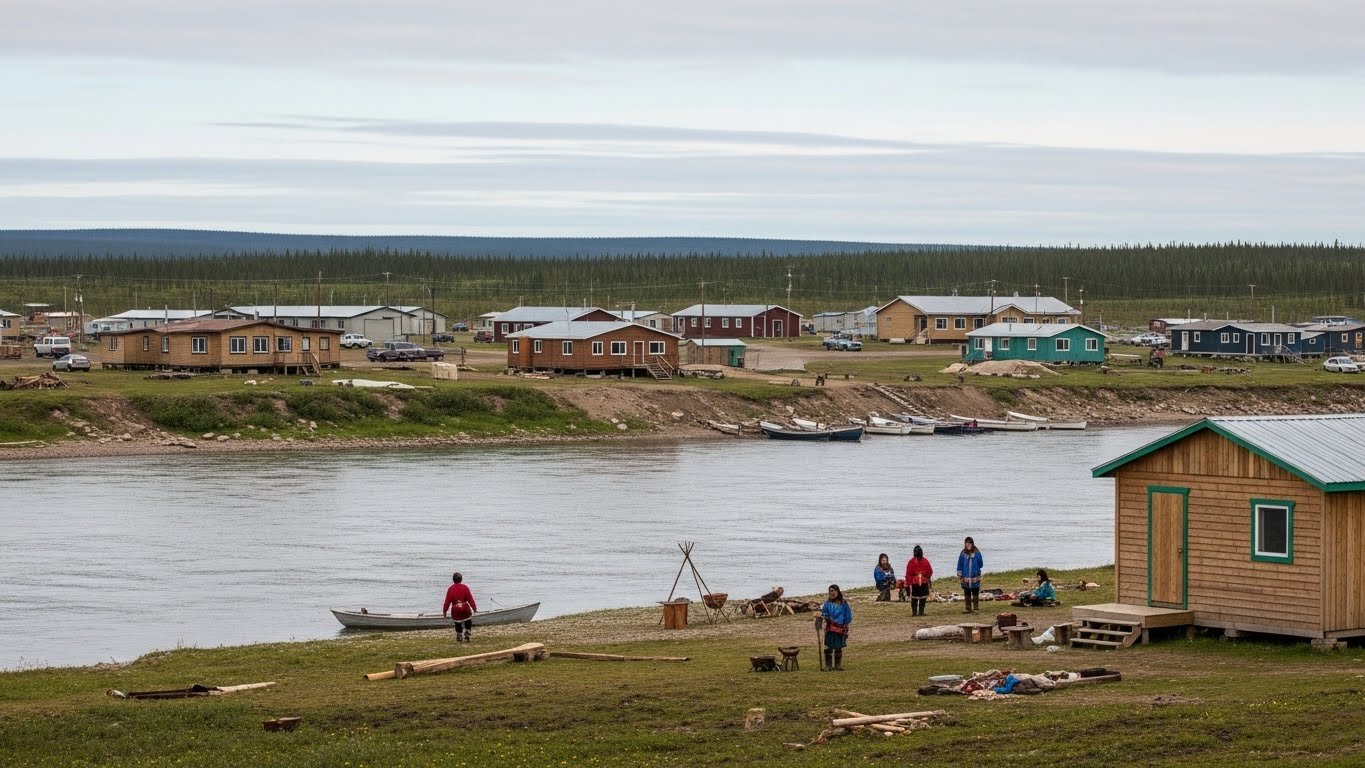

There are places you visit for landmarks, and then there are places you visit for meaning. Fort McPherson belongs firmly in the second category. This small but deeply significant community in the Northwest Territories is not about ticking off attractions—it’s about listening, learning, and feeling the rhythm of a culture that has thrived in the North for generations.
Located near the Arctic Circle, Fort McPherson is a proud Gwich’in community, rich in tradition, resilience, and connection to the land. As someone who has spent her life teaching, raising children, and learning from people and places across Canada and beyond, I find Fort McPherson profoundly moving.
This is a place that reminds us why we travel—not to consume destinations, but to understand lives different from our own.
Arriving in Fort McPherson: A Sense of Purpose
When you arrive in Fort McPherson, the first thing you notice is not grandeur—it’s groundedness.
The land stretches wide, the sky feels close, and the community carries itself with quiet assurance. Life here is shaped by the seasons, the river, and traditions that have endured far longer than roads or maps.
Fort McPherson doesn’t try to impress visitors. Instead, it invites them to slow down, observe, and appreciate a way of life that is deeply intentional.
A Proud Gwich’in Community
Fort McPherson is one of the most culturally important Gwich’in communities in Canada. The Gwich’in people have lived in this region for countless generations, developing a profound understanding of the land, wildlife, and seasonal rhythms of the North.
Culture here is not preserved behind glass—it is lived daily.
You see it in:
- the language spoken among elders
- traditional skills passed from grandparents to children
- respect for animals and the land
- the way community decisions are made
As a former teacher, I am always drawn to places where learning is intergenerational. In Fort McPherson, knowledge is not rushed—it is shared carefully, with responsibility.
Near the Arctic Circle: Life at the Edge of Extremes
Being close to the Arctic Circle shapes everything.
Here, daylight and darkness stretch to extremes. Winters are long and demanding; summers are filled with endless light and renewed energy. Instead of fighting these conditions, the community works with them.
Living near the Arctic Circle teaches:
- patience
- preparation
- cooperation
- respect for nature’s authority
For travelers, experiencing this environment—even briefly—reshapes perspective. You begin to understand how much of modern life is built on convenience, and how meaningful life can be when built on adaptation and care.
Strong Traditional Lifestyle
Tradition in Fort McPherson is not nostalgia—it is practicality.
Traditional practices continue because they work, because they are sustainable, and because they strengthen community bonds. Hunting, fishing, and land-based activities are not hobbies; they are expressions of identity and responsibility.
This traditional lifestyle fosters:
- deep environmental awareness
- self-reliance balanced with cooperation
- respect for elders and ancestral knowledge
- strong family connections
As a mother, I find this incredibly powerful. Children grow up knowing where food comes from, how weather affects life, and why community matters.
The Land as Teacher
In Fort McPherson, the land teaches constantly.
The rivers guide travel routes. The seasons dictate activity. Wildlife patterns inform planning. Nothing is taken for granted.
Travelers who spend time here—especially those willing to listen—will notice how closely daily life aligns with the natural world. This is not romanticized wilderness living; it is experienced wisdom.
For me, as someone who loves travel that deepens understanding, this connection is one of Fort McPherson’s greatest gifts.
Community Life: Small but Strong
Fort McPherson is not large, but it is deeply connected.
People know one another. Elders are respected and consulted. Celebrations and challenges are shared. This creates a sense of belonging that many larger places struggle to maintain.
Community life centers around:
- family
- cultural gatherings
- seasonal activities
- shared responsibility
There is a comforting rhythm to daily life here—one that values presence over productivity.
Cultural Importance Beyond Its Size
Despite its small population, Fort McPherson holds enormous cultural importance.
It is a place where:
- Gwich’in identity is actively protected
- language and traditions are reinforced
- cultural leadership extends beyond community borders
Visitors may not always see this influence immediately, but it is felt across the region. Fort McPherson stands as a reminder that cultural strength does not depend on size—it depends on commitment.
Seasons in Fort McPherson
Winter: Endurance and Unity
Winter here is serious business. Cold temperatures and long nights demand preparation and cooperation. Yet winter is also a time of closeness, storytelling, and shared resilience.
Spring: Renewal
As light returns, so does movement. The community transitions carefully, respecting the land as it changes.
Summer: Light and Life
Long daylight hours bring energy, travel, and outdoor activity. Summer is a time for teaching younger generations on the land.
Autumn: Preparation
Autumn is thoughtful and purposeful—a time to prepare, reflect, and pass knowledge forward.
Each season carries lessons, and Fort McPherson listens closely.
Food, Sharing, and Care
Food in Fort McPherson is deeply tied to tradition and respect.
Meals often reflect:
- local harvesting
- seasonal availability
- communal sharing
Food is not wasted. It is honored.
As someone who loves cooking and feeding others, I am always touched by how food becomes a bridge between generations here—connecting past knowledge with present care.
Traveling Respectfully to Fort McPherson
Fort McPherson welcomes visitors who arrive with humility and openness.
Respectful travel here means:
- understanding that this is a living community, not a display
- asking permission when appropriate
- listening more than photographing
- valuing stories as much as scenery
This approach leads to far richer experiences—and genuine connection.
Why Fort McPherson Matters to Travelers
Fort McPherson matters because it challenges common ideas of travel.
It reminds us that:
- culture is lived, not staged
- resilience can be quiet
- tradition and modern life can coexist
- some of the most meaningful places are the least flashy
For travelers seeking authenticity, Fort McPherson offers something rare: truth without performance.
A Community Looking Ahead
While deeply rooted in tradition, Fort McPherson is not frozen in time. The community continues to adapt thoughtfully, balancing modern needs with cultural preservation.
Education, governance, and cultural leadership remain priorities, ensuring that future generations can thrive without losing their identity.
As someone who believes deeply in passing values forward—to children, students, and communities—I find this balance inspiring.
💙 Final Reflections
Fort McPherson is not a destination you “do.”
It is a place you experience quietly.
A proud Gwich’in community, located near the Arctic Circle, and shaped by a strong traditional lifestyle, Fort McPherson offers travelers something increasingly rare: a reminder that meaning comes from connection—to land, to people, and to shared responsibility.
As Octavia O—teacher, mother, homemaker, traveler, and lifelong learner—I believe this with all my heart:
If you leave Fort McPherson with more questions than photos,
with more respect than expectations,
and with a deeper understanding of what it means to live well in harmony with the land—
then you have truly visited.
And that, to me, is the very best kind of travel.