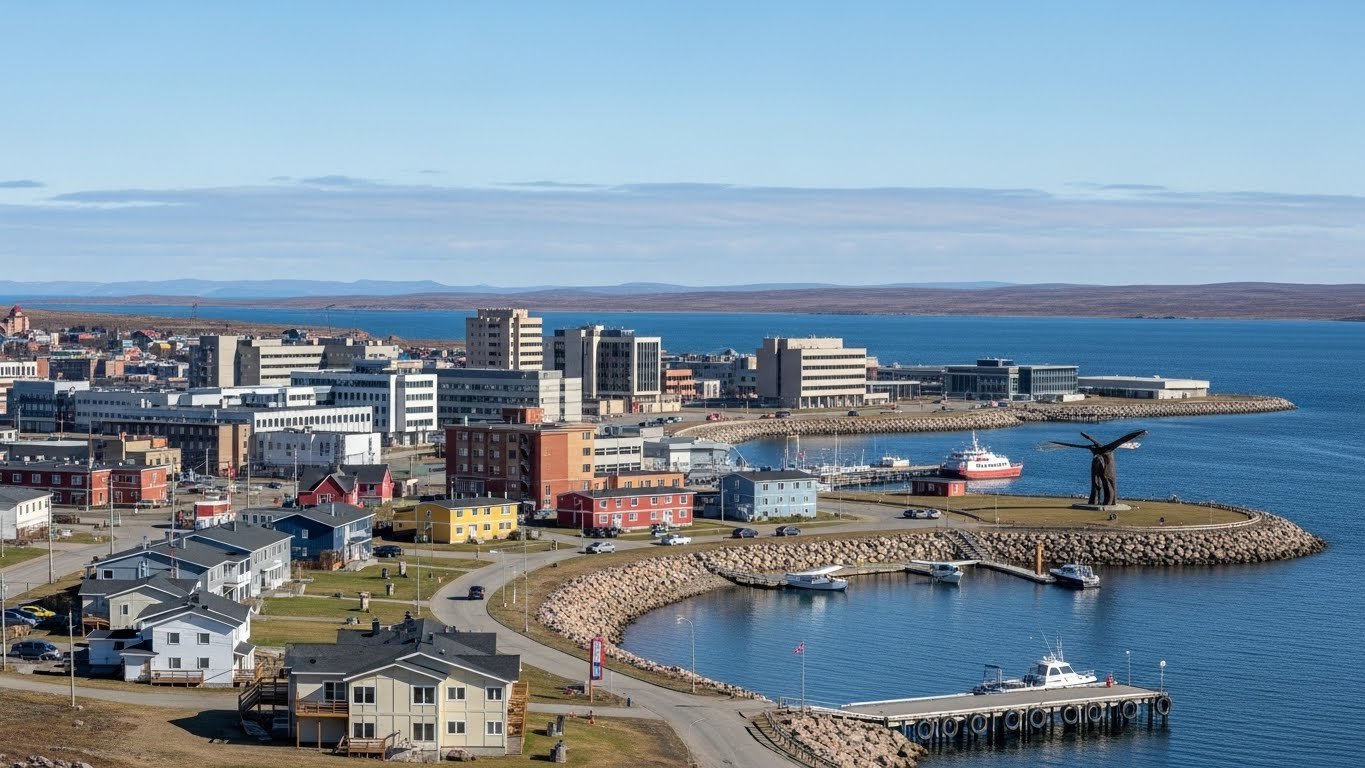

When people hear the word Arctic, many imagine endless ice, silence, and isolation. I did too—until I visited Iqaluit, a place that gently and confidently rewrites that story. Sitting proudly on the edge of Frobisher Bay on Baffin Island, Iqaluit is not just the capital of Nunavut—it is its heart.
As a mother, former teacher, and lifelong traveler, I’m always drawn to places where culture is lived, not displayed. Iqaluit is exactly that kind of place. It is modern yet traditional, resilient yet welcoming, remote yet deeply connected—to land, to people, and to stories that stretch back thousands of years.
This article is written for travelers who want more than a checklist. If you’re curious, respectful, and open-hearted, Iqaluit has a remarkable way of meeting you halfway.
First Impressions: A City Shaped by Land and Light
Arriving in Iqaluit feels like stepping into a landscape that speaks its own language. The tundra rolls gently toward the sea, rocky shorelines frame the bay, and the sky—so wide it almost feels protective—dominates everything.
Despite its northern location, Iqaluit does not feel cold in spirit. There’s movement here: people heading to work, children laughing outside schools, artists carrying supplies, elders sharing stories. It is a city built not in opposition to the Arctic, but in partnership with it.
Capital of Nunavut: Small City, Big Responsibility
As the capital and largest city of Nunavut, Iqaluit carries important responsibilities. It is the political, economic, and transportation hub of the territory, connecting dozens of remote communities spread across a vast Arctic landscape.
Government offices, schools, hospitals, and research institutions are all based here. But what struck me most was how governance and daily life remain closely tied to community values. Decisions are discussed, elders are respected, and cultural understanding shapes policy in visible ways.
This balance between leadership and community is something many larger cities could learn from.
Inuit Culture at the Center of Life
Iqaluit is a city where Inuit culture is not a footnote—it is the foundation.
You hear Inuktitut spoken in everyday conversations. You see traditional knowledge respected alongside modern education. You feel the presence of generations who have lived, hunted, traveled, and raised families on this land long before borders or capitals existed.
As a teacher at heart, I found this deeply moving. Knowledge here is not separated into “old” and “new.” It is layered, shared, and practical.
Arts, Crafts, and Storytelling
One of Iqaluit’s greatest joys is its arts scene. Creativity thrives here, shaped by the land, seasons, and lived experience.
Local artists work with:
- stone and bone carving
- printmaking and drawing
- textiles and contemporary mixed media
Each piece tells a story—of survival, humor, memory, and pride. Art here is not created for decoration alone; it is created to communicate identity.
Storytelling is equally important. Stories are shared in homes, schools, and community gatherings, passing on history, values, and laughter. As someone who has always believed stories connect generations, Iqaluit felt wonderfully familiar.
Gateway to Arctic Exploration
For travelers, Iqaluit serves as the gateway to Nunavut. From here, flights connect to smaller Arctic communities, research stations, and remote landscapes few people ever see.
But even if you never leave the city limits, Iqaluit offers a powerful introduction to the North:
- Arctic geography
- Indigenous governance
- climate research
- sustainable living in extreme conditions
Researchers from around the world come here to study climate, wildlife, and Arctic systems, working closely with local knowledge keepers. This respectful collaboration is one of Iqaluit’s quiet strengths.
Life Along Frobisher Bay
The relationship between Iqaluit and Frobisher Bay is intimate and constant.
The bay influences:
- transportation routes
- seasonal activities
- wildlife patterns
- community rhythms
In warmer months, the shoreline becomes a place for walking, reflection, and gathering. In winter, the frozen bay transforms into a highway and meeting place. Life adjusts, adapts, and continues—beautifully.
Watching this rhythm reminded me how adaptable humans can be when they truly understand their environment.
Seasons in Iqaluit
Winter: Strength and Stillness
Winter in Iqaluit is long, cold, and demanding—but also deeply social. People check on one another. Indoor spaces become warmer with conversation and shared meals. Northern lights often dance overhead, quietly reminding you of the planet’s vastness.
Spring: Patience and Transition
Spring arrives slowly. Ice retreats carefully. There is a sense of anticipation and respect for nature’s timing.
Summer: Light Without End
Summer brings near-constant daylight. Energy rises. Children play late into the evening, community events increase, and the land feels alive with possibility.
Autumn: Reflection and Preparation
Autumn is thoughtful. It is a time to prepare, to gather, and to reflect on the year ahead.
Each season teaches something—and Iqaluit listens closely.
Food and Community Sharing
Food in Iqaluit reflects both tradition and adaptation.
Local foods often include:
- Arctic char
- seal and caribou (prepared respectfully and traditionally)
- berries gathered seasonally
At the same time, modern grocery stores support everyday life. What matters most is not the menu, but the sharing. Food is offered, meals are communal, and generosity is part of daily life.
As someone who believes food connects hearts, I felt instantly at home.
Education and Youth
Education is a strong priority in Iqaluit. Schools work to balance curriculum with cultural knowledge, ensuring young people grow up confident in both worlds.
Children here learn:
- modern academic skills
- traditional land knowledge
- cultural values and language
Watching young people move comfortably between these worlds gave me great hope. It is proof that tradition and progress do not have to compete.
Respectful Travel: How to Be a Good Guest
Iqaluit welcomes visitors—but respectful travel is essential.
That means:
- learning before arriving
- asking permission when appropriate
- listening more than speaking
- valuing culture over convenience
Travelers who approach Iqaluit with humility often leave with far more than they expected—new perspectives, deeper respect, and lasting memories.
Why Iqaluit Stays With You
Iqaluit stays with you because it challenges assumptions.
It shows that:
- cities don’t need size to have significance
- culture can guide modern life
- resilience can be gentle
- leadership can be community-centered
For me, as Octavia—a mother, teacher, and woman who believes deeply in human connection—Iqaluit represents the kind of future we should be striving for: one rooted in respect, cooperation, and understanding.
💙 Final Reflections
Iqaluit is not just the capital of Nunavut.
It is a teacher.
It teaches patience through seasons, humility through landscape, and strength through community. It reminds travelers that the Arctic is not empty—it is full of life, knowledge, and warmth.
If you visit Iqaluit with an open heart, you will not simply see the North.
You will feel it.
And long after you return home, a part of you may still be listening to the wind over Frobisher Bay, carrying stories older than time—and still very much alive today.